
For nearly four decades, ASI has demonstrated a core competency in helping customers navigate technology trends. Building experience, maintaining prosperity, and accumulating longevity in an industry that is fast paced, ever-changing, and always looking towards the future. Part of ASI’s value to our customers is working to help determine which option in a vast ocean of solutions is the best fit for each use case. We serve as the BRIDGE between your engineering team and our manufacturing partners, an informational source, and guide through new and exciting innovations.
Many such innovations are taking place at NVIDIA, where engineers and system designers have been working not only to provide top-of-the-line gaming and enterprise products, but also to build and establish AI infrastructure that enables incredible new possibilities for the future. As part of this mission to create infrastructure, NVIDIA has developed multiple solutions tailored for industrial markets, working to help bring the latest innovations brought forth by emerging technologies such as Artificial Intelligence from being confined to massive datacenters to the edge and industrial environments.
Industrial markets can be among the most challenging spaces to build reliable systems that deliver the desired performance in a wide range of environments. System integrators need components that they can count on being available on the market longer than the traditional lifecycle of non-industrial components. They must be built to withstand the difficult conditions of deployment in environments such as the factory floor and therefore, must be resistant to dust, shock, water, and be able to operate in extreme temperatures. These systems must also be space conscious and power efficient, balancing these standards of durability and efficiency with the necessary processing capability for artificial intelligence at the edge.
Many have already been using NVIDIA products for their AI development and other needs. Using NVIDIA’s GPUs in creative or unorthodox applications powering their industrial systems with these commercial class components. While these devices can be capable of the processing power needed for such tasks, the problem is that these devices simply are not built to industrial specifications. They cannot be relied upon in harsh or heavy workload environments and they do not carry the extended lifecycle that is a necessary industrial PC standard. However, with few options that could match the processing capability, system integrators had to be resourceful. Today, as industrial solutions continue to grow in popularity across a variety of markets, NVIDIA has recognized the need for specialized components specifically designed to take on the needs of embedded and industrial system builders. NVIDIA’s industrial solutions bring their signature processing power to industrial applications while also maintaining consideration of the specific challenges system integrators are being met within these environments.
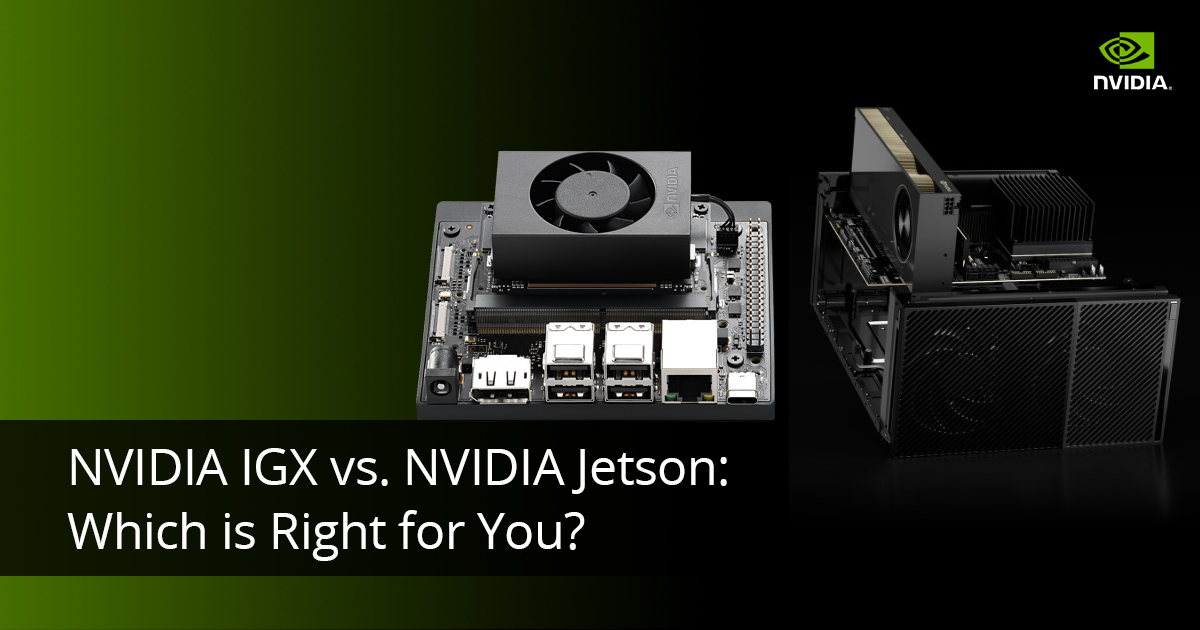
Currently, NVIDIA carries two major product lines, the IGX Orin and Jetson Orin, both of which are tailored to industrial environments, and both of which focus on vision-based applications. So, how does one determine the optimal solution for each use case? What makes an application suitable for the IGX rather than the Jetson, and vice versa?
The answer lies in two key capabilities of the IGX: real-time processing and built-in security features.
The built-in security features of the IGX such as ASIL-D functional safety readiness, redundant safety islands, and hardware monitoring help to accelerate development of systems that must undergo stringent and often lengthy processes of approval such as those in medical solutions and transportation. These safety features also make it an ideal solution for the manufacturing floor or other safety-critical applications.
The capability of real-time processing also makes it a necessary choice for applications where every second counts. Performing surgery, for instance, as well as the reflexes of a self-driving car. The need for real-time capability is a key indicator that the IGX is the ideal solution.
The different use cases of the Jetson and the IGX can be further illustrated by examining how a business might utilize both differently. For instance, a manufacturing floor may employ both the IGX and the Jetson. On the floor, Jetson systems are carrying out visual inspections of the product being manufactured to ensure quality, and each robot being deployed on the line uses a Jetson to operate and process its tasks locally. However, the IGX acts as the “supervisor” system, centralizing control of the robots, aggregating data on key performance metrics and ensuring all systems on the floor are functioning properly. In the event a malfunction does occur, immediate corrective action can be taken by the IGX to shut down the malfunctioning system.
Many are also using the Jetson to develop exciting innovations in security. The visual-based nature of the Jetson makes it great for facial recognition or other detection applications. The Jetson has also proved a popular solution in Agriculture, providing the same visual analysis for quality assurance applications the Jetson would be used for at a manufacturing facility.
Overall, both products have been designed with specialized considerations in order to thrive in challenging industrial environments. Both systems bring NVIDIA’s GPU-accelerated technology to industrial markets, in compact form factors with high efficiency and expandability, while also maintaining rugged durability. The Jetson is more suitable for a diverse array of visual applications while the IGX is designed for more safety critical situations and highly regulated markets. Both solutions are available today, at ASI.



Leave A Comment