
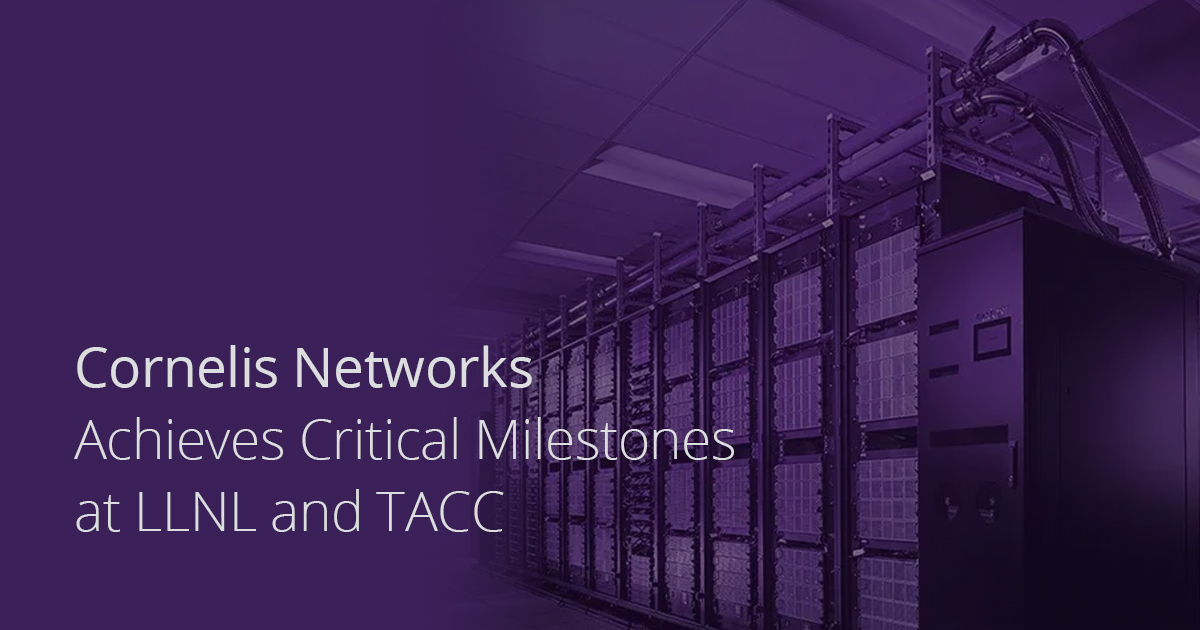
Powering the Future of HPC and AI: Cornelis Networks Achieves Critical Milestones at LLNL and TACC
The high-performance computing (HPC) and artificial intelligence (AI) markets demand immense processing power, but compute capabilities are only as fast as the network connecting them. Cornelis Networks has announced two major validation milestones with the formal deployment of the “Lynx” supercomputer at Lawrence Livermore National Laboratory (LLNL) and the official acceptance of the CN5000 networking upgrade at the Texas Advanced Computing Center (TACC).
These announcements prove that the Cornelis CN5000 Omni-Path® 400Gbps fabric is fully production-proven, highly scalable, and ready for demanding enterprise, academic, and government workloads.
Here is a look at these milestones and how they strengthen the case for next-generation, open-standards networking.
1. “Lynx” Supercomputer Enters Production at LLNL
The U.S. Department of Energy’s (DOE) National Nuclear Security Administration (NNSA) has successfully put the 952-node “Lynx” cluster into production at LLNL.
- The Architecture: Deployed in partnership with Dell Technologies, the cluster features Dell PowerEdge servers, Intel® Xeon® processors, and the Cornelis CN5000 Omni-Path fabric.
- The Mission: Operating under the NNSA’s Commodity Technology Systems (CTS-2) program, Lynx utilizes CN5000’s low-latency, lossless, and congestion-free 400G networking to power critical national security modeling and AI simulation workloads.
The Takeaway: Unmatched credibility. When organizations require absolute reliability for mission-critical business, the CN5000 fabric delivers—proven by its selection to secure and model national security infrastructure.
2. TACC Formally Accepts Stampede3 CN5000 Upgrade
The Texas Advanced Computing Center (TACC) has formally accepted a CN5000 networking upgrade supporting a key compute partition within the Stampede3 supercomputer.
- The Architecture: The deployment upgraded more than 600 compute nodes, serving over 5,000 active open-science researchers annually.
- The Performance: Benchmarking on the widely used Weather Research and Forecasting (WRF) model demonstrated outstanding performance gains ranging from 53% to 71%.
The Takeaway: Quantifiable ROI. For academic, research, and enterprise environments looking for faster time-to-result, this deployment provides real-world data demonstrating massive performance improvements by upgrading to the CN5000.
Redefining the Fabric Landscape: What This Means for the Market
These back-to-back achievements change the conversation for organizations building out modern AI and HPC infrastructure:
- An Alternative to Proprietary Fabrics: Organizations are increasingly pushing back against vendor lock-in, long lead times, and astronomical pricing. The CN5000 offers a high-performance, open-standards alternative that drastically lowers Total Cost of Ownership (TCO) while offering elite congestion management and scalable performance.
- An Ecosystem-Ready Solution: The Lynx deployment highlights deep integration and alignment with industry leaders like Dell, AMD, and Intel, making it seamless to attach Cornelis networking to existing server and storage pipelines.
- Mitigated Risk: Stringent government and academic acceptance testing removes the perceived risk of adopting a new fabric architecture, validating its readiness for enterprise deployment.
Capitalize on the Momentum
The era of compromise in high-performance networking is over. With proven deployments at LLNL and TACC, the Cornelis CN5000 Omni-Path 400Gbps fabric stands as a premier choice for modern workloads.
Reach out today to discover how integrating Cornelis Networks can differentiate your infrastructure, lower your TCO, and accelerate your most demanding computational pipelines.
Additional Resources:
Cornelis Customer Webinar – ASI Technology Summit
ASI Blogs:
Cornelis – Network Performance for AI Inference and Edge Computing
The Token Economy: Maximizing AI Efficiency at the Edge with Cornelis Networks
The Rise of Cornelis Networks – Unlocking AI/HPC Performance with Omni-Path and Ultra-Ethernet



Leave A Comment