
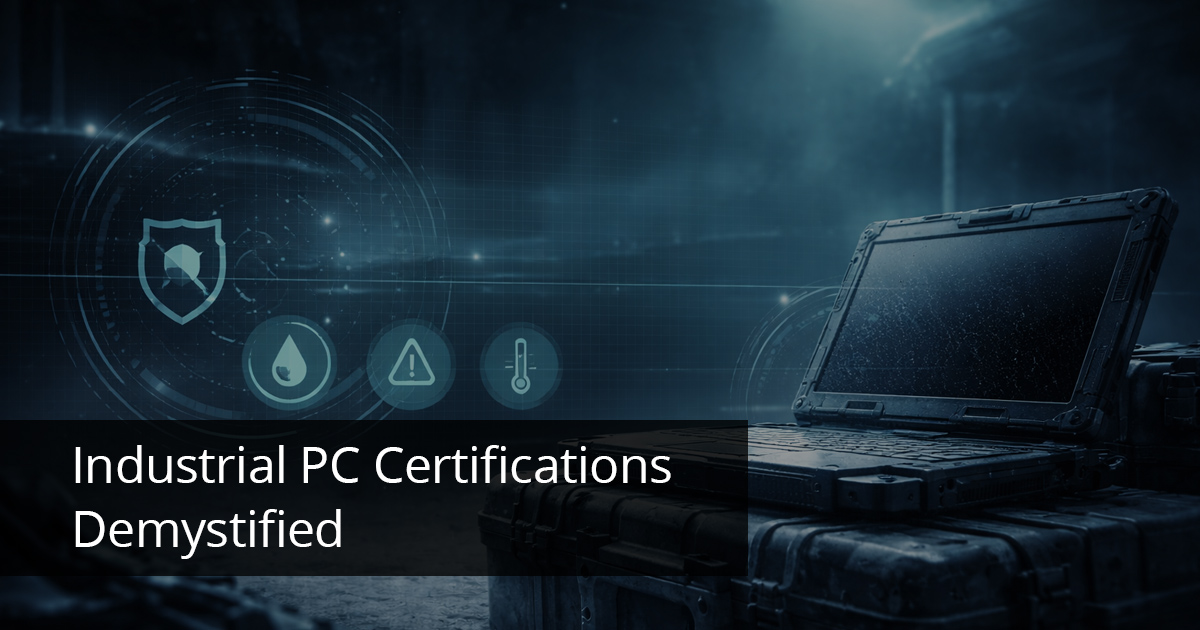
In rugged computing, it has become essential for manufacturers and resellers alike to be aware of and adhere to certain standards that have become universal across brands. These standards, such as MIL-STD-810H, are most likely terms you have heard increasingly frequently. Understanding these standards allow buyers to map durability to hard specs rather than generic language. So, what exactly does it mean? What kind of testing must be passed in order for these certifications to be earned? This article will break down common IPC standards and certifications, what they mean, and their importance to success in rugged computing.
Contents
- The Challenge
- IP Standards
- MIL-STD Standards
- UL Standards
- IEC Standards
- ISO Standards
- AS Standards
- FCC Standards
- The Solution
The Challenge
Rugged computing requires systems to be built with components that are resistant to many environmental challenges such as dust, vibration, extreme temperatures, and more. Because these systems will be pitted against these harsh conditions, procurement teams cannot rely on nonspecific terms or unproven systems. Manufactures producing IPC components must rigorously test their product so they can earn these third-party certifications, and prove that their system is reliable under the many challenging conditions an industrial PC may face in deployment.
IP Standards
Ingress protection ratings, or IPs, are used to classify the ability of the device’s electrical enclosure to withstand and resist elements such as dirt and water. The first digit in the number denotes a device’s resistance to dust and other solid foreign objects, and the second digit indicates resistance to water.
- IP65- protection against water splashing or jetting onto the device up to 30kPa 3 meters away for at least 15 minutes.
- IP66- protection against water splashing or jetting onto the device up to 100kPa 3 meters away for at least 3 minutes.
- IP67- Able to be fully submersed in water for 30 minutes at a depth of at least 1 Meter
- IP68 – Able to be fully submersed in water for over 30 minutes at a depth of at least 1 Meter
- IP69K – The highest Ingress Protection rating available, certifying the above levels of compliance with additional protection meant for devices that will undergo pressure washing or steam cleaning.
All the above standards also certify full protection against dust particles, as denoted by the first digit of the number (6).
MIL-STD Standards
Standards developed by the American military, products with these certifications meet various standards for military-grade durable hardware suitable for use in harsh environments and must be highly reliable.
- MIL-STD-810H – Tests for low pressure, high and low temperatures (including temperature shock) rain (including freezing rain), humidity, shock and vibration. Due to is comprehensive nature, MIL-STD-810H is one of the most widely recognized standards in IPC.
- MIL-STD-461G – Tests for electromagnetic interference, to ensure the system does not interfere with other systems nearby. This includes testing the device’s ability to withstand unwanted signals and operate properly while being exposed to radiated and electric magnetic fields.
- MIL-S-901 – Tests for shock, specifically designed to be used to determine if a system is ship-shape.
UL Standards
UL standards are some of the most widely recognized standards not just in industrial computing, but in the world. Their scope goes beyond the range of electronic devices.
- Facility Certifications – based on how well an operation adheres to healthcare safety regulations and standards
- Personnel Certifications – Certifies all employees have a baseline skill and knowledge set.
- Process Certifications – Certifies business processes meet applicable standards and requirements for regulations and more.
- Product Certifications – Most commonly seen in industrial computing. Examples include UL 3100 or UL1740, certifying safe robotics.
- System Certifications – evaluates a collection of processes individually as well as how they work together in a system.
IEC Standards
IEC are another widely adopted set of independent standards specifically testing environmental resistance from conditions such as extreme heat, cold, corrosion, humidity, and vibration. Each of the aforementioned conditions have their own set of IEC testing standards associated with them.
- IEC 60068-1 – Defines the general methods and severity levels of testing
- IEC 60068-2-1 – Low temperature.
- IEC 60068-2-2 – high temperature
- IEC 60068-2-6 – random or sinusoidal vibrations
- IEC 60068-2-27 – sudden impacts
- IEC 60068-2-78 – high humidity and condensation
- IEC 60068-2-11/52): corrosion resistance.
- IEC 60068-2-14 rapid thermal fluctuations.
- IEC 60945: Set of testing standards specifically to qualify hardware for maritime operation.
ISO Standards
ISO standards are some of the more broad and comprehensive set of standards as they go beyond computer hardware and its typical industries. They are also unique in that they can apply to companies and not just specific products. As such ISO standards asses for manufacturing and quality control practices in addition to hardware performance.
- ISO 9001 – standards of quality control and management.
- ISO 14001 – Environmental impact of an organization
- ISO 27001 – Secures sensitive information
- ISO 45001 – Reduces workplace accidents
- ISO 22000 – Manages food safety hazards.
- ISO 26262, AKA ASIL. For the most heavily regulated industries such as transportation and medical. Requires high level functional safety at hardware and software levels.
AS Standards
AS standards are based on ISO standards, adding industry specific criteria for aviation, airspace, and defense.
FCC Standards
The FFC and correlative set of standards go beyond the scope of electronic hardware. The standards put in place the by the FCC for computer hardware tests EMC and RF emissions to ensure the device is not susceptible to, nor a potential source of, interreference.
The Solution
By understanding these standards and certifications and what they mean, procurement teams are able to understand the different hardline standards a product was able to meet, and compare testing certifications against their requirements to secure product and components that they know they can rely on.
ASI’s industrial PC partners manufacture products that adhere and go beyond these standards. With over 30 years of experience in distribution and a track record of established success, ASI understands the value of a trusted supply partner who is attuned to your individual needs as a business. ASI can help consolidate sourcing and serves as your bridge to our manufacturing partners.




Leave A Comment